Pact for Skills: Support to the Transformation of the TVET System in Ghana
The Pact for Skills: Support to the Transformation of the TVET System in Ghana is a collaborative effort commissioned by the German Federal Ministry for Economic Cooperation and Development (BMZ) and the European Union (EU).It is implemented by Deutsche Gesellschaft für Internationale Zusammenarbeit (GIZ) together with the Ministry of Education, the Commission for Technical and Vocational Education and Training (CTVET), the Ghana TVET Service (GTVETS), and the University of Skills Training and Entrepreneurial Development (USTED).

As part of the broader EU-Ghana Pact for Skills initiative, the project supports the efforts of the Government of Ghana in building a strong, future-ready TVET system that equips young people with industry-relevant skills. Through this partnership, the project strengthens institutional management and reforms, enhances the capacities of TVET teachers and workplace facilitators in Competency-Based Training (CBT), and deepens collaboration with the private sector to ensure training meets labour market demands.
Beyond technical skills, the project is driving Ghana’s transition towards a greener and more digital future, empowering learners with the competencies to innovate, create jobs, and contribute to sustainable national growth.
Project Duration: 2023 – 2026
Project Regions: Greater Accra, Eastern Region, Volta Region, Ashanti Region, Northern Region and Western Region
Training providers:
- Dabokpa Technical Institute
- Koforidua Technical Institute
- Kpando Technical Institute
- Kumasi Technical Institute
- St. Paul Technical Institute
- Takoradi Technical Institute
- Tema Technical Institute
The project supports the implementation of CBT programmes in Biodigester Construction, Building Construction, and Recycling Technology at six of these institutions.
Project Outputs
- System Steering (Output 1): The project strengthens the implementation of key regulatory and strategic reforms by supporting steering processes and piloting sustainable financing mechanisms for TVET institutions. The creation of CTVET and GTVETS provides a structured regulatory framework for the TVET sector, ensuring effective administration and implementation of policies.
- Quality Delivery (Output 2): TVET teachers, workplace facilitators, and institutional heads are trained in CBT methods, with a focus on digital, environmentally friendly, and inclusive approaches to improve instructional quality and learning outcomes.
- Collaboration for Employment (Output 3): The project builds partnerships between TVET institutions and industry actors through Sector Skills Bodies (SSBs) and through Workplace Experience Learning (WEL), job fairs, internship opportunities, and employer roundtables. This promotes active industry involvement, ensuring that TVET programmes are aligned with industry needs and support a smooth transition from education to employment.
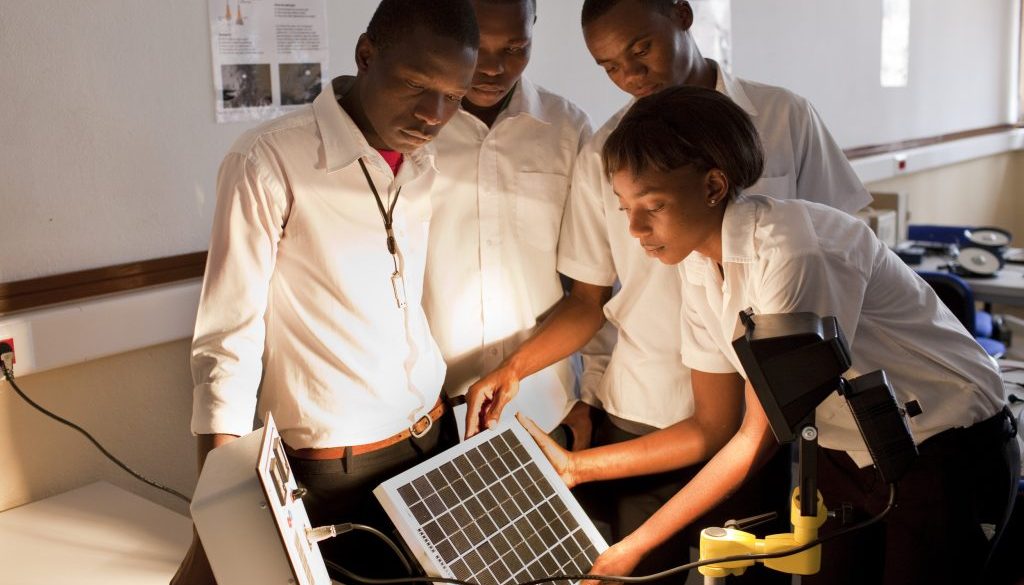
Green Skills for Green Growth and Digital Transition (Outputs 4 and 5): TVET in green and digital fields equips learners with the skills needed for emerging jobs, while also preparing
- the economy to meet future requirements. By focusing on sustainability and digital innovation, it supports a workforce ready for the green transition and technological change.
- Diversity and Inclusion: The project also facilitates capacity-building initiatives that focus on providing inclusive access to TVET, addressing gender disparities.
Key Action Points
- Employability
- Private Sector Integration
- Green and Digital Jobs
- Gender Equality & Social Inclusion
- Institutional Strengthening & Reform
- Innovation & Sustainability in Skills Development
What we have achieved so far
A National Policy for TVET: Supported key state actors in developing Ghana’s first National TVET Policy to strengthen regulation, coordination, and quality assurance across the TVET system.
Capacity Building: Strengthened the competencies of 4,035 professionals (2,446 men; 1,589 women) through training in CBT and WEL, including 2,850 TVET teachers and 1,185 workplace facilitators, to enhance training quality and labour market relevance.
Increased Enrolment: Enrolled 1,543 learners (1,306 men; 237 women) in CBT programmes, 919 in Building Construction, 370 in Biodigester Construction, and 254 in Recycling Technology, promoting inclusive access to industry-relevant skills.
Gender Inclusion: Supported 120 female students in women-only classes to develop skills in Recycling Technology.
Greener TVET Institutions: Three TVET institutions are supported to meet international standards for greening their campuses, curricula, communities, and institutional culture.
Workplace Experience Learning: Facilitated 177 partnerships between companies and TVET institutions, enabling 977 learners to gain hands-on experience in real industry settings, bridging the gap between classroom learning and workplace demands.
Graduation Success: 213 learners achieved a National Certificate II in Building Construction and Biodigester Construction, ready to contribute to national productivity and economic growth.
Learner Support: Supported with the provision of insurance, stipends, accommodation, and transport support, as well as Personal Protective Equipment (PPE) to ensure learner welfare, safety, and readiness for practical training.
Learning Materials: Supplied 1,144 teaching and learning materials to six TVET institutions to enhance the delivery of CBT courses.
Digital Transformation: Trained 850 TVET professionals in IT and digital skills and established an EdTech Node (digital hub) and a Multimedia Authoring lab at GTVETS to connect headquarters and regional offices, strengthening coordination and digital readiness across the TVET system.
Figures as of February 2026
These achievements reflect the joint commitment of the German Government, European Union, and Government of Ghana to building a future-ready workforce through inclusive, industry-aligned, and practical skills development for sustainable national transformation.