The Commission for Technical and Vocational Education and Training (CTVET) has organized a one-day sensitization workshop for Trade Associations and Training Providers on the commencement strategy for Recognition Prior Learning (RPL).
Recognition Prior Learning was developed by the Commission in collaboration with GIZ, Ghana Skills Development Initiative (GSDI) IV and designed to evaluate prior skills and knowledge acquired through informal or non-formal learning; against pre-determined qualification standard in order to formally recognize them.
The first phase of the project will be implemented in the Electronics and Garment Making trade areas in three (3) regions of Ghana – Greater Accra, Northern and Ashanti.
Facilitators from the Accreditation, Assessment and Certification Directorate of CTVET took participants through stages of the model. Mr. Emanuel Amankwaah, Head of Registration and Accreditation was lead facilitator. He made a presentation on the Information and Application stage, a portfolio of evidence of activities (pictures or videos) undertaken in the trade area required from the candidate before assessment. He finally talked about the payment process and cautioned that applicants are to submit their forms to selected Training Providers only.
The Evidence Judgement Stage was facilitated by Head of Unit of the Certification department, Mr Eric Nyarko; while Mr. Stephen Morrison, Head of Unit at the Accreditation department took the participants through the process of Verification and Verification under the RPL model.
About 60 participants attended the workshop held at the Education Village Conference Centre in Accra.
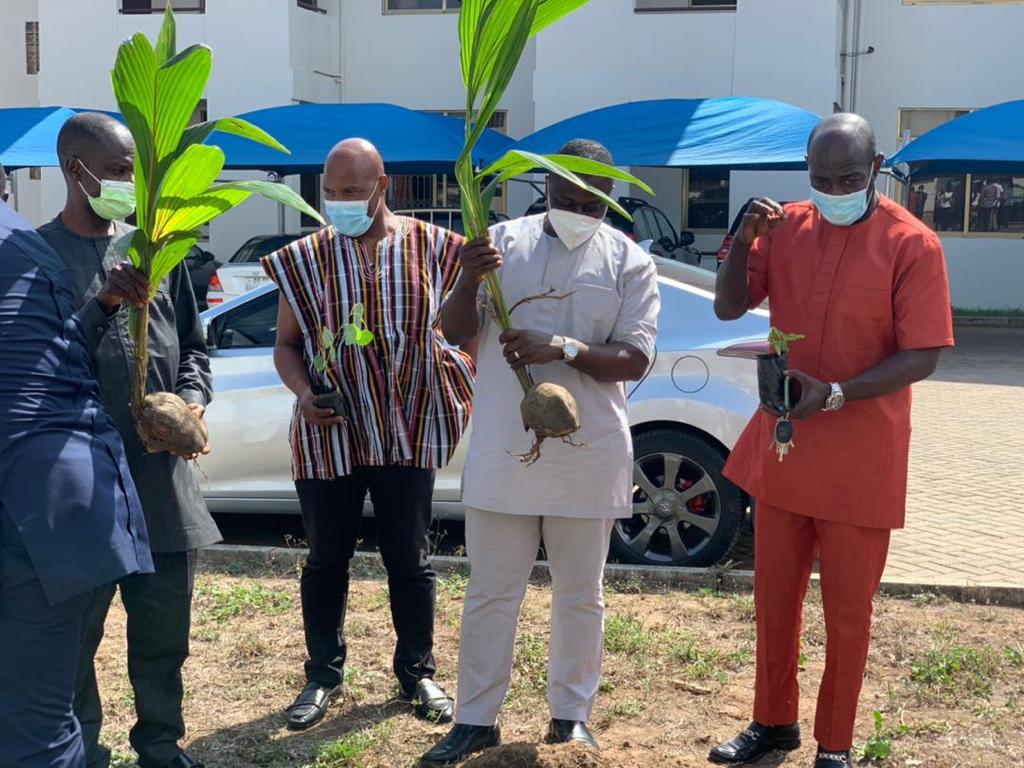
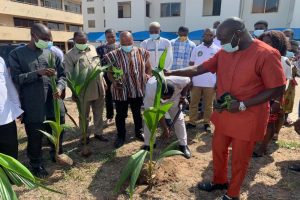
The Commission for Technical and Vocational Education and Training led by the Ag. Director General Dr. Fred Kyei Asamoah, today embarked on a tree planting exercise at the Commission’s premises as part of the “GreenGhanaDay” Campaign.
The campaign which was launched in April 2021 by the Lands and Natural Resources Ministry, is part of a strategy to protect Ghana’s forests and the environment, through the planting of 5 million trees on June 11, 2021.
The Commission for Technical and Vocational Education and Training (CTVET) organized a working session on Greening TVET at the Tomreik Hotel in Accra.
The workshop brought together 40 heads of Technical and Vocational Institutes (TVIs) to discuss the challenges and opportunities in practising Greening in TVET Institutions, to enable them develop Institutional Greening Plans (IGP).
In his opening remarks, the Ag. Director General of CTVET Dr. Fred Kyei Asamoah, underscored the importance of strengthening the awareness and knowledge on greening to prepare learners for the emerging jobs and new opportunities that transitioning to a green economy will create.
“We need to train and equip these learners, our future labour force, to accept greening philosophies to change their thinking and mindset,” he added.
He charged the participants to be change agents and champion the path to “transforming the learning/training environments in their schools and the society at large, by developing and implementing effective green strategies.”
The Coordinating Lead for the Planning, Project, Research Monitoring and Evaluation (PPRME) Directorate of CTVET Mr. Samuel Thompson, in his presentation said, “there are various things we do that affect the environment negatively and these have consequences on future generations. Almost every sector has been affected by these negative practices and all the solutions to these negative practices are found in the TVET sector.”
President of the Association of Principals of Technical Institutions (APTI) Mr Benjamin Adjabeng expressed satisfaction at the insights gleaned from the workshop.
“In our next meeting, we will come out with a policy that will improve upon tree planting, check erosion and encourage recycling in the schools,” he added.
The workshop delved into green concepts, potential green job areas, SDGs and Greening TVET; how to green the campus, curriculum and training and research, among others.
BACKGROUND
Greening TVET for environmental sustainability is one of the major pillars under the 5-year Strategic Plan for #TVET Transformation.
A delegation led by the Ag. Director General of the Commission for TVET (CTVET) Dr. Fred Kyei Asamoah paid a working visit to the Ho Technical University and the Mpehuasem Campus of the Accra Technical University on Saturday 5th June, 2021.
The purpose of the visit was to inspect ongoing projects under the Ghana-China Project on the Rehabilitation and Upgrading of Equipment in Technical Institutes (including Technical Universities)
The project is being implemented to improve the employability of the Ghanaian youth by providing them with the relevant skills and competencies required for self and formal employment.
This project will see the provision of state of the art tools and equipment to 30 Technical Institutes and all the Technical Universities across the country. as well as the construction of a construction of Technical Examinations Unit Block (TEUB) at the Akenten Appiah-Menka University of Skills Training and Entrepreneurial Development (AAMUSTED).
The Commission for Technical and Vocational Education and Training (CTVET) has inaugurated the Sector Skills Bodies (SSBs) Secretariat at the Head Office of the National Vocational Training Institute (NVTI) in Accra.
The secretariat, financed by the Ghana Skills Development Initiative III (GSDI), is expected to serve as an office facility for the SSBs to conveniently conduct their activities.
Speaking at the event the Minister for Education Hon. Dr Yaw Osei Adutwum, who was the Guest of Honour, noted that he is excited to inaugurate such a body and is hopeful they would bring their expertise on board to help in the development of the youth.
He said¸ “the establishment of sector skills bodies is an essential vehicle that brings together relevant private sector industries, industry professional bodies, relevant government institutions and education and training institutions together to explore and address the present and future workforce needs of industry. This is indeed one of the surest ways by which we can all together tackle the skills mismatch challenges between what is needed in industry and what is being supplied by the training institutions.”
Swiss Ambassador to Ghana H.E. Philip Stalder, in his short address noted that he is pleased with the setting up of the Secretariat and is very optimistic that Ghana will benefit fully from Technical and Vocational training through the establishment of these Skills Bodies.
GIZ Country Director Regina Bauerochse Barbosa, said GIZ was pleased to partner the Commission on various projects including the construction of the SSBs secretariat, to enhance the face of TVET in Ghana.
She added that the establishment of the SSBs was an essential step towards labour market demand-driven, competency-based training and applauded the Government of Ghana for the “bold steps it is taking to restructure and harmonise the technical and vocational education training landscape in the country.”
“The Ghana Skills Development Initiative implemented by GIZ will continue to support capacity building measures to the Sector Skills Bodies to enable them to fulfil their mandate, she said.”
The Ag. Director General of CTVET Dr Fred Kyei Asamoah said that it was paramount for industry to be at the centre of skills development to provide the right environment for the creation of employment opportunities.
“I am proud that the Ministry for Education through CTVET is ensuring that industry leads the way in terms of skills training through the setting up of Sector Skills Bodies; to focus on the exploration of business opportunities, innovation and capacity needs within identified sectors of the economy.
It is our sincere hope that through your work, we will find practical solutions to the challenge of skills mismatch and be adequately prepared for future skills needs,” he said.
He also commended International Labour Organization (ILO), GIZ, Konrad Adeneur Stiftung (KAS), AHK, Ford Foundation, SECO/ Switzerland Government, and European Union for joining forces and succeeding in making the setting up of the SSBs a reality.
Eight (8) newly established Sector Skill Bodies (SSBs) were also inaugurated at the event. They are: Pharmaceuticals, Automotive, Oil & Gas, Renewable Energy, Textiles Garment & Apparel, Healthcare, ICT, Logistics & Transportation.
Background of SSBs
As part of government’s TVET transformation strategy to improve upon the governance and management of TVET, 22 Sector Skills Bodies are being established by the Ministry of Education through CTVET.
Sector skills bodies are a group of related industries that come together under a common structure to drive growth and competitiveness across the sector.
They focus on exploration of business opportunities, innovation and capacity needs within the sectors.
The Commission for Technical and Vocational Education and Training (CTVET) has organized a one-day sensitization workshop for principals of technical and vocational institutions, on the conduct of 2021 Certificate II Core Subjects Examinations.
About 200 principals of technical and vocational institutions and their staff attended the workshop held at the Education Village Conference Centre.
Educating participants on the Education Regulatory Bodies Act 2020 (Act 1023), Ag. Director General Dr Fred Kyei Asamoah, in his welcome address said that the Commission is now better positioned to give learners the confidence to demonstrate and fulfil their potential.
Dr Peter Boahin, Coordinating Lead for Standards, Curriculum Development and Enforcement Division, said the workshop was part of efforts to ensure that examinations were conducted in a smooth and fair manner and reduce the incidence of examination malpractices.
He entreated participants to ensure strict supervision to deter candidates from cheating and detect irregularities.
“We started using nose masks not long ago but I have reports on my desk that some candidates write reference material on these masks. You need to be extra vigilant as they are becoming more ingenious in their ways,” he said.
Mr. Sampson Damptey Tettey, Coordinating Lead for Accreditation, Assessment and Certification Division, indicated that Technical and Vocational Education and Training (TVET) has shifted from a supply-led to a demand-led approach; leading to the conversion of training programmes into Competency-Based Training mode, to equip learners with practical experience to be better prepared for the world of work.
He added that “institutions should put the requisite structures in place to make teaching and learning in this mode effective.”
Staff of the Accreditation & Certification Unit took turns to take participants through the rules and regulations for dealing with cases of irregularities; the roles and responsibilities on the conduct of exams and the concerns of the Commission on the conduct of the exams.
During the workshop, participants actively took part in discussions and were given the opportunity to ask questions; which were answered by the staff of the Commission.
Your Excellencies (Members of the Diplomatic Corps)
Heads of institutions
Industry Partners
Friends from the Media
Distinguished Invited Guests
Ladies and Gentlemen
I am extremely excited to welcome you all to this inauguration of the Sector Skills Bodies Secretariat.
On behalf of the Commission, I would like to express our sincere gratitude to the Hon. Minister for Education Dr. Yaw Osei Adutwum for graciously accepting to be here this morning. This truly is a testament of Government’s commitment to the strengthening of TVET to better enable its skilled workforce contribute to national development.
Ladies and Gentlemen, Ghana has a youthful population. With the right technical and vocational education and training, coupled with national strategies and policies that provide the right environment for the creation of employment opportunities, they would be the nation’s greatest asset for development.
One of the avenues to realize this is through partnership with industry. So, I am proud that the Ministry of Education through CTVET is ensuring that industry leads the way in terms of skills training through the setting up of Sector Skills Bodies; to focus on the exploration of business opportunities, innovation and capacity needs within identified sectors of the economy.
Members of the bodies have all been selected for their various contributions and experience in their respective sectors.
It is our sincere hope that through your work, we will find practical solutions to the challenge of skills mismatch and be adequately prepared for future skills needs.
Ladies and Gentlemen, we are gathered here to observe two very important milestones. The inauguration of the newly established SSBs in the following sectors; Textiles, Garment and Apparel, Logistics and Transportation and Health Care. We will also witness the official inauguration of the office for the Sector Skills Bodies.
The building we inaugurate today is going to serve as an office facility for you to conveniently conduct your activities.
Hon Minister, Excellencies, the establishment of eleven (11) Sector Skills Bodies, with another 11 more to go; has been the result of the commitment and hard work of dozens and dozens of people. I would like to say a big thank you to all who have made this possible.
To our partners GIZ, European Union, International Labour Organization, Ford Foundation, KAS – Konrad-Adenauer-Stiftung, AHK – German Chambers of Commerce Abroad; we truly appreciate your unflinching support!
May our bond of friendship continue to grow in the ensuing years.
I hope I will not be out of line if I say the doors of this secretariat are always open to all. Please do come by and let us all join forces to strengthen skills development to achieve the Ghana we all envisage.
Acting Director-General for the Commission for Technical and Vocational Training (CTVET), Dr Fred Asamoah has disclosed that the Commission is working closely with industries to equip students with competency and job required skills.
According to him, the Commission has moved away from supply based training and is now focused on demand based training, where industries in which graduating students are to find themselves, are an integral part of the development of CTVET curriculum.
“We are making sure Technical and Vocational institutions have the required infrastructure to train students and also meet international standards. The curriculum being used to train students is the industry based one and that is how we set the kids up for life after school. Now we don’t just focus on supplying the job market but we work with the industry and are informed about the kind of experts they need and we produce them.” he stated.
Dr Fred Asamoah noted that CTVET works in a regulatory position and makes sure processes work. “It means we improve vocational training and now we look at the demand in the market and make sure students can fill in the existing gaps after graduation and that helps students a lot.” he reiterated.
The educationist noted that Technical and Vocational institutions have now moved from simply training and getting students to memorise to focusing on competency-based training which is dominated by constant demonstrations.
To promote consistent skills-based training to meet industry standards, the government is focused on equipping Technical and Vocational institutions with the necessary infrastructure to compete with the international community.
“Now, technical institutions have upgraded infrastructure and equipment that match up to, and in some cases are more improved than what we have in some of our universities. We once had a German partner visit one of our institutions and was surprised our equipment were up to date and matched up to what they had. We should know that the world skills competition does not focus on different standards so we need to make sure our standards are up to international standards and prepare students with the required skills for the world market.” the CTVET boss indicated.
On his authority, informal training in Technical and Vocational institutions is being replaced with innovation and research which will ultimately lead to the reduction of the importation of finished products into the country.
“We don’t want the situation where the Ghanaian can only fix cars but get to the point where we make and export cars too.” he intimated.
Dr Fred Asamoah made this known in an engagement with the Ghana Education Service under the theme; ‘Positioning Ghana’s Education for Sustained Development’, the first of the novel series under the umbrella, ‘Happy FM Development Dialogues’ spearheaded by the Epa Hoa Daben political talk show.
The Commission for Technical and Vocational Education and Training (CTVET) in collaboration with the Ford Foundation established three (3) Sector Skills Bodies for the Textiles Apparel & Garment, Logistics & Transportation and Healthcare Industries; from 19th – 21st May 2021. The event took place at the Commission’s Conference Room.
In his opening remarks, the Ag. Director General Dr Fred Kyei Asamoah, expressed gratitude to members of the Sector Skills Bodies (SSB) for agreeing to work with the Commission to develop a skilled workforce that is responsive to the needs of their respective sectors.
He indicated that their role is central to achieving government’s 5-year strategic plan to build a robust TVET system. Dr Asamoah further expressed the hope that they will be committed to duty and live up to their mandates.
For his part, Dr Peter Boahin, Coordinating Lead for Standards, Curriculum Development and Enforcement Division (SCD & E) said deliberate efforts have been made to adopt an industry-led approach to develop curriculum to curb the challenges of mismatch between skills training and labour market demands. He also informed them about the upcoming inauguration of the SSB secretariat to be held on 28th May, 2021.
Ms Edith Adotey of SCTD & E, spelt out the terms of reference and guidelines for the selection of leaders for the bodies.
Supervising the election of three (3) executives each for all the SSB, Mr Theophilus Tetteh Zogblah of SCTD & E, urged members to be mindful of the need for the bodies to be run by employers; supported as necessary by other sector stakeholders.
Leadership of the SSB commended CTVET for the various interventions in the design and delivery of TVET and pledged to discharge their duties diligently, to help produce a globally competitive skilled workforce for Ghana.
The 19-member Textiles Apparel and Garment SSB will be led by Ms. Salma Salifu (Chairman), Mrs Linda Ampah (Vice Chairman) and Dr William Kwesi Senayah (Secretary).
The 16-member Logistics and Transportation SSB will be led by Rev Godwin Douglas Mensah (Chairman), Mr Danny Laud (Vice Chairman) and Dr George VanDyck (Secretary).
The 20-member Healthcare SSB will be led by Dr Yaw Opoku (Chairman), Mrs Sena Hiadzi (Vice Chairman) and Dr Mrs Susan Ama Amuasi (Secretary).
BACKGROUND
Sector Skills Bodies are a group of related industries that come together under a common structure to drive growth and competitiveness across the sectors. They focus on the exploration of business opportunities, innovation and capacity needs within the sectors.
They have been established among others things, to make recommendations to CTVET to ensure that qualifications, curriculum and learning materials reflect the occupational standards and that learning materials are also widely accessible; advocate and facilitate greater linkages between skills attainment, professional standards, payment regimes and the TVET system and also advocate for government and other incentives to encourage industry to invest in skills development and TVET.
The Commission for Technical and Vocational Education Training (CTVET) held a staff meeting on the 12th of May 2021, with a call on staff to improve upon work punctuality and put in extra effort in order to achieve the mandate of the Commission.
In his welcome address, the Ag. Director General, Dr. Fred Kyei Asamoah, expressed his gratitude to the staff for their continuous commitment and cooperation towards the progress of the commission.
He said that there will be new office allocations following the merger of COTVET and NABPTEX, to foster teamwork and cohesiveness.
Dr. Asamoah encouraged management to ensure that they discharge their duties diligently through proper supervision and monitoring.
He further shared information on other work- related issues and urged staff to work hard because of the bigger task ahead.
Staff were given the opportunity to air their opinions and ask questions, which were duly addressed by the Director General and the Co-ordinating leads.
At the close of the meeting, the Co-ordinating lead for Human Resource, Mrs. Agnes Balasu thanked staff for attending the meeting at such notice and entreated staff to keep a right attitude to work. She added, “the transformation of the TVET agenda lies on the doorstep of every department.”










 He said that there will be new office allocations following the merger of COTVET and NABPTEX, to foster teamwork and cohesiveness.